
The Danger of Being Indispensable

For a long time, I thought being needed was evidence of good leadership.
Then I was “relieved of my duties”. Over the next 90 days, the school ran just fine without me.
In fact, it had its best year ever academically!
That's when I learned an important lesson:
Being indispensable can feel like leadership while actually preventing leadership capacity from developing.
Our job isn't to become the answer to every problem.
It's to develop people and systems capable of producing results without our constant intervention.
Leadership question:
Where have you accidentally made yourself indispensable?
What Happens When Your Hero Leaves?
Every school has heroes.
And we should celebrate them.
But there's a dangerous question leaders need to ask:
What happens when the hero leaves?
If one teacher holds an entire program together...
If one administrator knows how everything works...
If one board member carries governance...
If every difficult decision eventually comes back to the Executive Director...
you don't just have great people.
You may have organizational dependency.
High-performing schools absolutely need great people.
But great people should strengthen the system—not become the system.
Ask yourself today:
Where would our organization struggle immediately if one key person disappeared tomorrow?
That may be where your next system needs to be built.
Great people matter.
But here's the uncomfortable question:
What stops working if your best person leaves tomorrow?
That question can expose an organizational vulnerability faster than almost anything else.
People create excellence.
Systems make excelle...
Stop Solving the Same Problem
Here's a question I ask leaders all the time:
What problem have you solved more than three times this year?
Maybe it's late lesson plans.
Poor meetings.
Parent communication.
Employee accountability.
Student discipline.
Board confusion.
Enrollment.
If the same issue keeps returning, I'd challenge you to stop looking only at the person involved.
There may be a system underneath the problem that is either weak, unclear, inconsistently implemented—or completely missing.
Pick one recurring frustration today.
Then ask:
What would we need to build so this problem doesn't require me to solve it again?
That's systems thinking.
What problem are you tired of solving?
Not the biggest problem.
The one that keeps coming back.
What system could you build, clarify, or improve so this problem stops coming back?
Solving the problem once is progress; building a system that prevents it from returning is leadership.
When Hard Work Hides a Weak System

School leaders are some of the hardest-working people I know. So when a school isn't getting the results it wants, I don't immediately assume people aren't working hard enough.
Sometimes the opposite is true.
We've created an organization where good people have to work extraordinarily hard because the systems around them aren't working.
Think about the process that only works because Sarah remembers everything. Or the principal who personally solves every discipline problem. Or the Executive Director who has to approve every decision.
That's not high performance.
That's dependence.
So here's today's leadership question:
Where is your team compensating for a weak system through extraordinary effort?
Because working harder may solve today's problem.
Building the system can solve it tomorrow.
School leaders don't have an effort problem.
Many have a repeatability problem.
If success depends upon your best people remembering, rescuing, reminding, fixing, and following up every t...
The Small Moments That Build Your School’s Culture

Culture isn’t built during one big staff meeting.
It’s built one interaction at a time.
How you greet someone.
How you respond to the teacher asking the same question again.
Whether you start meetings on time.
Whether you follow through.
What you celebrate—and what you tolerate.
Especially at the beginning of school, people are watching.
They’re trying to determine:
What really matters around here?
Here’s the problem: Leaders often focus on the big culture-building events while overlooking the hundreds of small interactions happening every day.
But those interactions are the culture.
From now on, slow down and notice the small moments.
Because:
Culture isn’t what you say you value. Culture is what people consistently experience.
Everything matters.
Make today count!
Stop Assigning Tasks. Start Creating Ownership.
“Complete this.”
“Send that.”
“Implement this.”
“Have this done by Friday.”
Sound familiar?
Leaders spend a lot of time assigning tasks.
Here’s the problem:
Tasks without context create compliance—not commitment.
People need to understand more than what they’re doing.
They need to understand why it matters.
Where are we going?
What does success look like?
How does my work contribute?
When people understand the strategy, they don’t just complete tasks.
They begin making better decisions without you.
That’s when ownership increases.
So before assigning the next task, take another 60 seconds and explain the WHY.
Don’t just assign the work.
Connect the work to the mission.
Top 10 Ways to Prepare a New School Administrators for Success

- One of the biggest mistakes I made as a school leader was assuming talented administrators knew how to build their own success plan.
I thought:
"They're smart."
"They have experience."
"They'll figure it out."
Sometimes they did.
Often they struggled unnecessarily.
What I've learned is this:
The first 90 days belong to the supervisor.
Your job isn't just to hire great people.
Your job is to create the conditions for their success.
Here are ten ways to do that.
1. Build the First 90-Day Plan for Them
Don't tell a new administrator to create a transition plan.
Create one together.
Outline:
-
Key relationships
-
Critical meetings
-
Learning priorities
-
Early wins
-
Major responsibilities
The first 90 days should be intentionally designed.
2. Clarify Success Before Day One
Most administrators are hired with a job description.
Few are given a definition of success.
Answer:
What does success look like at 30, 60, and 90 days?
3. Introduce Them to ...
Lesson #4: Commitment — Why Nothing Changes Until Someone Owns It

You can have:
- Clear priorities
- Strong communication
- Aligned leadership
…and still get no results.
Why?
Because nothing changes until someone commits.
The Leadership Frustration
Every leader has said this:
👉 “We talked about that…”
👉 “We agreed on that…”
👉 “Why isn’t it happening?”
Because agreement is not commitment.
And clarity is not execution.
The Real Problem
Most teams operate in interest, not commitment.
- “That’s a good idea”
- “We should do that”
- “Let’s try that”
That’s not commitment.
That’s conversation.
What Commitment Actually Means
Commitment means:
- Someone owns it
- It has a deadline
- It will happen—no matter what
👉 Commitment removes ambiguity.
The Commitment Standard
If you want results, every initiative must answer:
- Who owns this?
- What exactly will be done?
- By when?
If one of those is missing…
👉 It’s not a commitment.
Why Leaders Avoid Commitment
Let’s be honest—this is where it gets uncomfortable.
Leaders avoid commitment bec...
Lesson #3: Cascade Communication: Why Your Message Isn’t Sticking (And What to Do About It)
Most leaders think they have a communication problem.
They don’t.
They have a consistency problem.
You said it once.
Your team heard it once.
And then it disappeared.
And now you’re frustrated because:
- People aren’t aligned
- Execution is inconsistent
- Priorities feel unclear
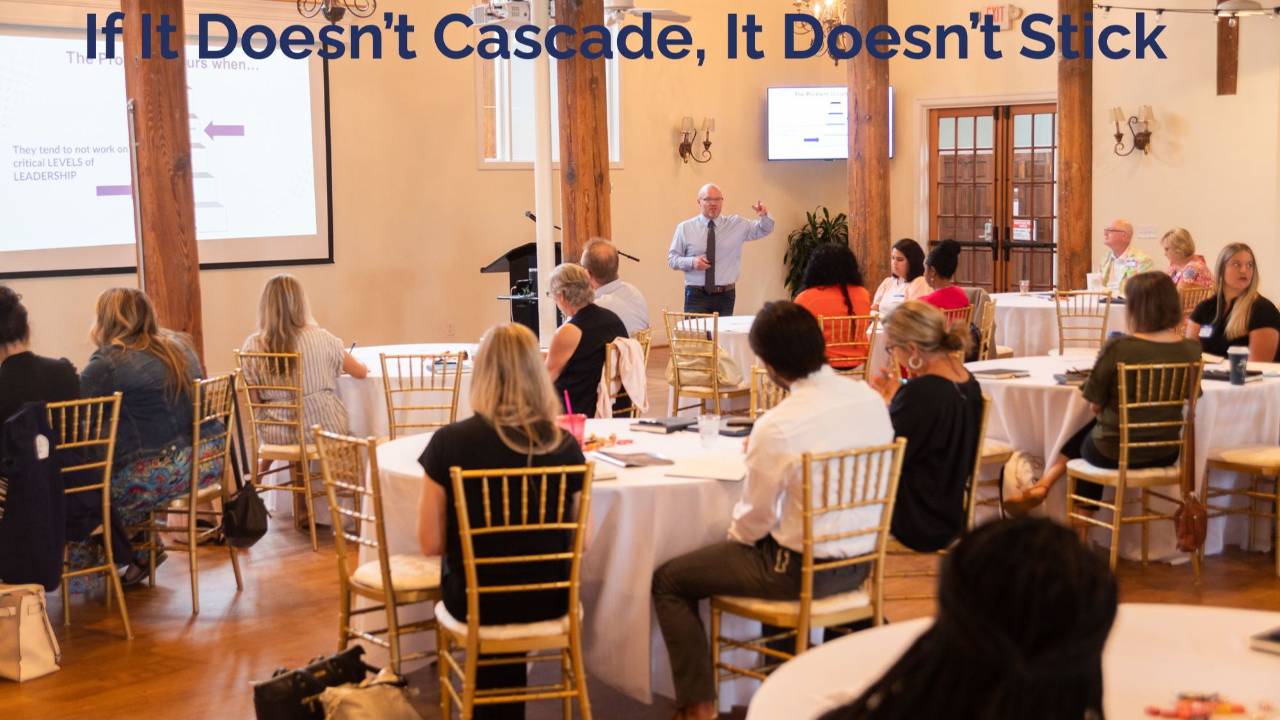
👉 If it doesn’t cascade, it doesn’t stick.
The Real Problem
In most organizations, communication looks like this:
Leader says it → meeting ends → everyone interprets it differently.
By the time it reaches classrooms, departments, or teams…
…it’s a completely different message.
That’s not communication.
That’s distortion.
What Cascade Communication Actually Means
Cascade communication is not about saying more.
It’s about ensuring the message is:
- Consistent
- Repeated
- Reinforced at every level
From leadership → to teams → to execution.
Not once.
Repeated until it becomes behavior.
The Leadership Gap
Here’s where most leaders get it wrong:
- “I said it” = “They got it”
- Leaders reword inst ...
Lesson #2: Clarity Creates Accountability: Why Your Team Isn’t the Problem

After working with over 150 schools intimately and supporting leaders across 30+ states and multiple countries, one of the most common frustrations I hear is this:
“We just need more accountability.”
But when I dig deeper, that’s rarely the real issue.
It’s a clarity problem.
The Leadership Trap
Most leaders try to fix performance by increasing pressure:
- More check-ins
- More follow-up
- More conversations
- More consequences
But none of that works long-term…
If people aren’t clear on what they’re accountable for.
The Real Issue
You cannot hold people accountable to unclear expectations.
And yet, this happens every day in schools and organizations.
Leaders assume:
- People know their roles
- People understand priorities
- People know what success looks like
But assumption is not clarity.
What Lack of Clarity Looks Like
When clarity is missing:
- People stay busy—but not productive
- Priorities shift depending on the day
- Leaders step in more and more
- Teams feel microm ...
